After years of minimalist designs with muted colours and strict grids, 2026 sees a creative counter-movement. Websites are becoming more emotional, more human and more intelligent. For SMEs in Switzerland, this means: updating your website now secures a tangible competitive advantage.
1. Dopamine Design: Making a Bold Colour Statement
Rich, vibrant colour palettes are displacing the restrained tones of recent years. Neon gradients, bold contrasts and Y2K-inspired aesthetics dominate, especially among lifestyle, beauty and tech brands. Brands like Lush and Headspace are already using this strategy to trigger positive emotions in users.
For Swiss SMEs, this doesn't mean blindly following every trend. But a targeted colour accent – such as a vivid gradient in the hero area or an eye-catching CTA button – can measurably increase conversion rates. Pantone may have chosen the restrained Cloud Dancer (PANTONE 11-4201) as the Color of the Year 2026, but the contrast between a calm base and targeted colour accents creates the greatest impact.
2. Organic Layouts: Breaking Free from Rigid Grids
After a decade of strict grid systems, layouts are loosening up. Flowing shapes, soft gradients and anti-grid designs give websites personality and warmth. This development reflects a broader need: the more automated and AI-driven the digital world becomes, the more users crave humanity in design.
This can be implemented with CSS clipping paths, irregular image masks and blob shapes as design elements. Important: the organic elements must support usability, not hinder it. Readability and clear hierarchies remain non-negotiable.
3. AI-Powered Personalisation
AI in 2026 is no longer a toy but a functional tool in web design. Websites adapt layout, content and navigation in real time to user behaviour. Tools like Dynamic Yield or Insider enable automatic visitor segmentation and delivery of the most relevant content.
For SME websites, this often starts more simply: an AI-powered chatbot that proactively guides visitors through the site, or personalised product recommendations based on scrolling behaviour. The key is that these features are implemented in a GDPR-compliant manner – especially important in Switzerland with the revised Data Protection Act (revDSG).
4. Light Skeuomorphism and Glassmorphism 2.0
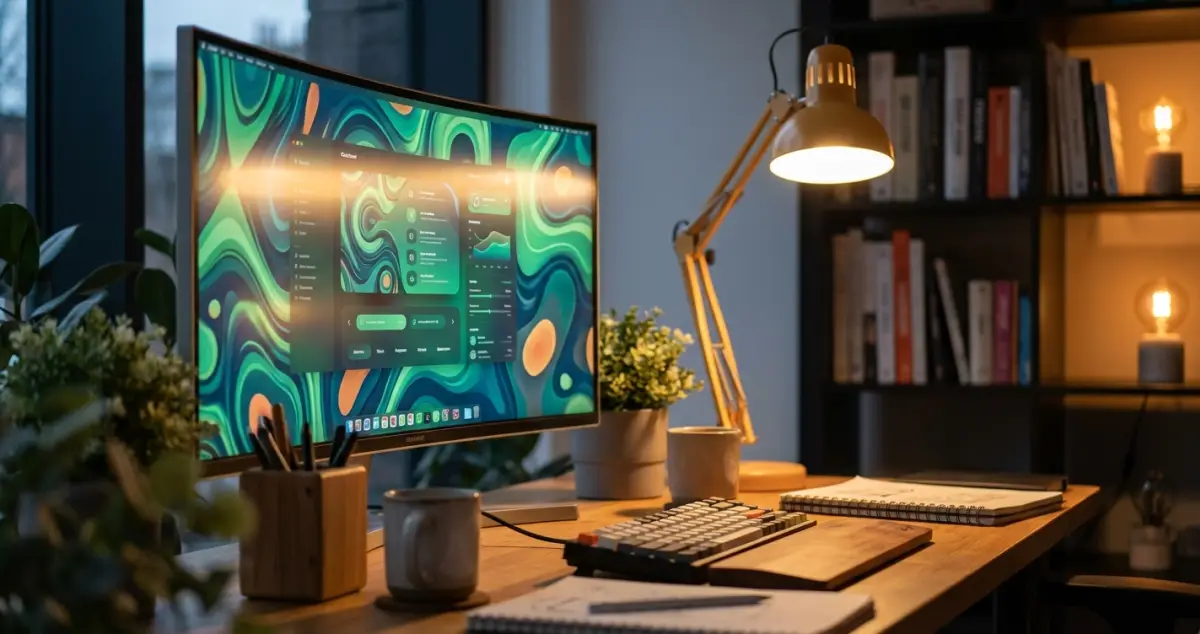
Apple's Liquid Glass has elevated glassmorphism from a short-lived trend to a mature design system. Frosted glass panels, translucent layers and diffuse shadows create depth without impacting performance. At the same time, a light skeuomorphism is returning: subtle shadows, gentle gradients and slightly raised elements give interfaces a haptic quality.
Thanks to modern blur APIs and improved browser performance, these effects can now be implemented without noticeable loading time penalties – a major difference from earlier iterations of this design language.
5. Sustainable Web Design as Standard
Sustainability in web design is no longer a niche topic in 2026. The W3C Web Sustainability Guidelines (WSG 2.0) define standards for energy-efficient design. Lean code, optimised images and green hosting measurably reduce the CO2 footprint of digital products. At the same time, performance benefits: lighter websites load faster and rank better.
Swiss companies subject to the Corporate Sustainability Reporting Directive (CSRD) must document their Scope 3 emissions – this includes the energy their websites consume. Sustainable web design is therefore not only ecologically sound but increasingly regulatory relevant.
6. Accessibility-First Design
Accessibility is shifting from an optional improvement to a baseline requirement in 2026. High colour contrasts, screen reader support, voice navigation and keyboard operability are standard in modern web design. The European Accessibility Act (EAA), effective from June 2025, makes this mandatory for many digital products and services.
For agencies and companies in Switzerland, this means: an accessibility audit should be part of every website project – not as an add-on, but as an integral part of the design.
Conclusion: Humanity at the Centre
The web design trends of 2026 share a common thread: more humanity in an increasingly automated world. Whether through emotional colour palettes, organic shapes or AI-powered personalisation – successful websites combine aesthetics with function and put the user at the centre.
Want to bring your website up to date in 2026? Contact Sidora AG for a no-obligation initial consultation – we analyse your potential and identify concrete areas for action.